









Not even a few decades ago, artificial intelligence was viewed as a domain of specialized, narrow applications that pertained to specific, noteworthy tasks. It was in 2011 when a special team of researchers from IBM presented their jeopardy wizard, Watson, who triumphed over man, and, not long before early voice assistants like Siri were showcased to the public. Then, artificial intelligence, or AI, was celebrated for its particular, impressive feats that cemented it as a theoretical hallmark of the future. Perception from the general public was far from the apprehension seen today across adults and the rising generation of children and youth.
Today, AI has branched itself across practically every part of society. It can assist and dictate in areas ranging from text and image generation to decision making. Most notably, students have found themselves at the heart of this artificial intelligence revolution. Recent research conducted by the Center of Democracy and Technology (CDT) shows that roughly 85% of K-12 students have reported to use AI tools, as per the 2024-25 school year, while nearly half of those students have admitted to using AI writing tools at least once.
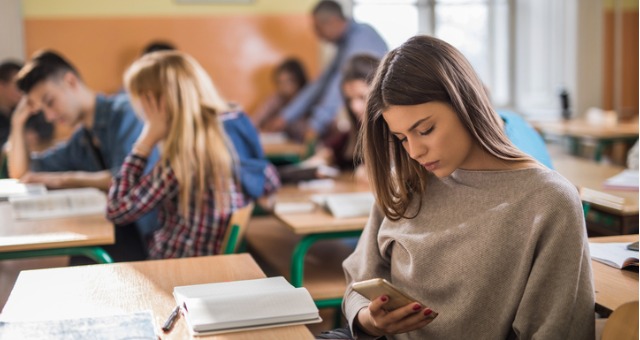
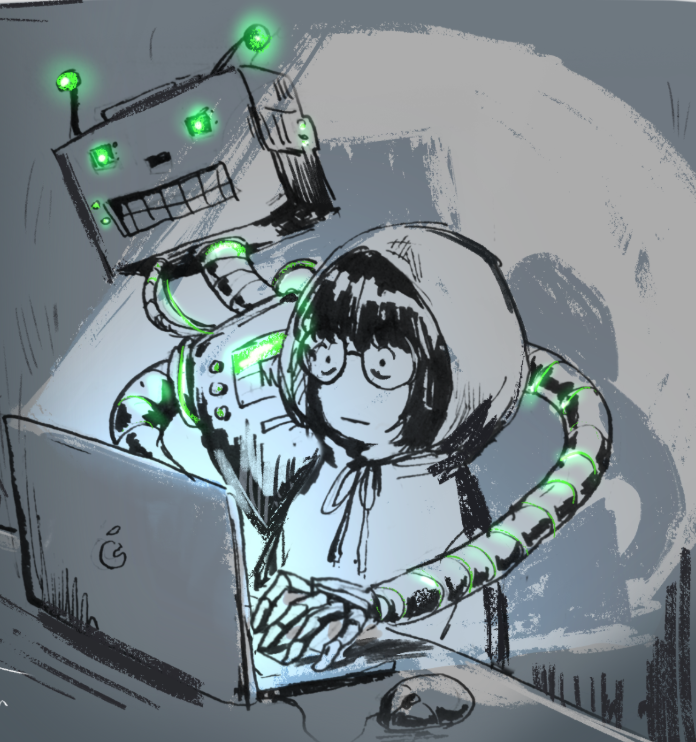
AI, while capable of enhancing education, currently is being overused by students in ways that weaken their critical thinking, undermine teacher-student relationships, and encourage academic dependence. This growing reliance is evident as AI has cemented itself in students’ learning, with it not only being used as a tool of assistance, but more concerningly, to complete an overwhelming portion—if not all—of their homework. This offers a dangerous shortcut for students to bypass using their own minds, forcing them to become more dependent on automated tools. Especially in stressful environments, students often find themselves relying on using AI tools to promptly finish their work. This overreliance weakens crucial skills, like critical thinking and writing.
Interestingly, an underlooked consequence of AI is its noticeable damage to relationships between students and teachers. According to a report released by the CDT, fifty percent of students agree that using AI in classrooms has hurt their ability to create meaningful connections with their teachers. AI and generative tools can lead to mistrust between teachers and students, further eroding their relationships. In addition, the rise of AI in schools has concerned parents and teachers alike, with half of both parties expressing their concerns that it has decreased peer to peer interaction.
Others argue that AI use in school can benefit students and allow them to prepare for an AI-integrated future. AI enables personalized learning while also being able to provide a faster and more targeted learning service for students. Additionally, by automating monotonous tasks, AI reserves time for teachers to connect more with their students.
However, responsible use of AI is simply sparse throughout schools. Students have failed to use AI tools and technology responsibly and for their benefit, leading to a cascade of problems that ironically weakens what AI promises to help with; student-teacher relationships. Reliance on AI-detectors can create a mistrust dynamic in the classroom while the growing trend of students over relying on AI has increasingly caused students to feel less of a need to engage with their instructors.
It’s easy to let AI do too much cognitive thinking, especially under the ever-stressful lives of many students. Irresponsible use of AI, which is rampant among students across schools, is taking away skills of writing, reading comprehension, and cognitive ability from the next generation of people. Without proper intervention, AI is plundering the productive struggle of students that allows them to grow and more importantly, think independently. Responsible use of AI tools and technology can bring back a once distant reality that rightfully glorified the outbreak of artificial intelligence, re-stamping it as a hallmark of beneficial assistance and human achievement.