




























It was the final week of my eighth grade school year. Since I had first walked into middle school two years prior, I had been in all the accelerated courses from Math and Science to History and English. This was also before the race for class Valedictorian was as competitive as it is here in the high school. Needless to say, during a ‘Social Studies Superlative’ activity, my classmates voted me; “Most Likely to Attend Harvard.” Yes, Harvard. Historically the epitome of academic success on this side of the Atlantic Ocean (and likely globally for some). And yet, what exactly does it matter beyond the prestige of the name recognition? I’d argue, very little.
First and foremost, just as any opinion I write is subjective, so is the idea of the wholesale college experience. It is thus impossible to separate fact from fiction in determining a ranking without some level of subjection. Beyond this, since one size does not fit all in our modern culture, it is misleading at best to suggest any college can definitely be better than the rest. Yet using historical precedent, test scores, and graduation rates, our societal condition of comparison between socio-economic factors dictates a select list of “Ivy Leagues” as the most elite schools one can attend out of high school.
Secondly, college is not meant to be the end goal in anyone’s life (unless you intend on becoming a lifelong professor – which is rare and besides the point). Rather, any university from those with “Ivy League” status to the least heard-of community college, has the primary purpose of preparing their students for specialized jobs in the real world that require degrees where employee output should dominate in a meritocracy. So maybe it would come at a surprise to some that a recent study from the Wall Street Journal actually showed markedly similar career earnings in spite of (not despite) which college a person attended.
Additionally, let’s be frank here and not pretend like college is not a business. It absolutely is, and if you want proof of this fact outside of your own perception, just ask a friend or relative to see how much tuition they were/are paying to these institutions. With this in mind, many of the resources offered to prestigious universities such as Stanford, Yale, Brown, and Harvard provide “teaching” opportunities mostly under the guise that the job constraints will give more time for potential research as opposed to actually offering lecture students more personalized learning points.
Now if you thought we hit a dead-end, you’d be wrong! We haven’t even touched upon ROI yet. Return On Investment. If you approach any college – not least among them being the Ivy League academies – with the economic viewpoint of opportunity costs into heavy consideration, very few reasonable people would conclude that simply attending such an establishment for the “bragging rights” is fiscally wise. Take for example the study that showed the impossibly high sticker price (currently over $90,000) for many middle-class families amidst even further rising tuition rates would inevitably lead to massive debt and unrealistic loans…only to be met with a salary that can questionably pay this back at best within the alumni’s first 10 years in the career sector. If this is seen as prestige, it’s no wonder our own country reflects such a blatantly irresponsible status where our national debt just months ago began outpacing our 39 trillion dollar valued GDP.
Although, I’d also be lying to you if I said there are no counterarguments to my claim. Opponents would suggest a combination of factors actually sustain a favorable prestige for such colleges. Ranging from competitive waitlisting practices, historically acclaimed networking opportunities, “need-blind” admission focus, higher than average SAT scores, even to salary statistics that solidify that 0.8% of their students make up 12% of Fortune 500’s most-successful CEOs; Does all this raise a point? Yes, and no. Yes, in that historically, no one is denying prestige exists or has existed. But I would suggest this reality if fading…and fading fast. I say this because if any Ivy League claims to be such an uplifting force for enlightenment regardless of personal economic status, how come mass disenfranchisement exists? According to the New York Times, only 2-5% of total students make up a representation of America’s working lower class? Even if networking exists for attendees, isn’t that under false pretenses and actually irrelevant if most students that don’t come from wealth can’t even make it past the admissions filter?
If you need a tangible example of this, look at the educational background of the former U.S. President John F. Kennedy. In response to the Harvard essay prompt, “Why do you wish to come to Harvard?” He wrote just five sentences! “The reasons that I have for wishing to go to Harvard are several. I feel that Harvard can give me a better background and a better liberal education than any other university. Then too, I would like to go to the same college as my father. To be a ‘Harvard man’ is an enviable distinction, and one that I sincerely hope I shall attain.” However, because of many disclosed financial donations to the university, Kennedy’s own father, Joseph P. Kennedy, played most of the role in enabling his son to attend (as opposed to merit which was lacking in such a short response). In the more modern era, 17 private ‘Ivy League’ universities, including Brown, Columbia, Cornell, Dartmouth, Duke, Emory, Georgetown, Johns Hopkins, MIT, Northwestern, Notre Dame, Rice, Vanderbilt, Yale, University of Chicago, University of Pennsylvania, and Caltech were collectively accused in a class-action suit of price fixing and allegedly reducing the financial aid for over 200,000 students in an illegal manner. 12 such named institutions have settled with millions in momentary value, thus far outside of court.
Let’s also stop pretending that prestige comes from the school buildings themselves. Rather, intelligence that fuels primary prestige comes from the students and teachers that built these places as early as their individual founding dates to be credible establishments for college education. Yet in 2025, the Manhattan Institute found remarkably that only 15% of the total voter base in America trusts in the “Ivy League” level of education that they are being sold as a Veblen Good (an economic term referring to products that manage to break the standard laws of a capitalist market by tying their heightened prices to consumer demands, which convinces the population that a desire can become a need). With the integration of test-optional (SAT, ACT, etc.) policies at most Ivy Leagues since the COVID-19 Pandemic that still linger, I would claim there is a reasonable argument that intelligence scores produced by taking a standardized test is no longer meaningful, even by their own standards of abandonment. So why then would a person from a rural background in the state of New York, for a hypothetical scenario, go into massive student debt to attend Cornell, when they can go to “New Ivies” like SUNY Geneseo, SUNY ESF, Paul Smith’s College, or SUNY Poly (which are all more affordable and still esteemed by employers in specialized fields) and get similar, diplomas – in terms of post-undergrad opportunity availability? If the students and professors built the prestige in the 18th century of these schools, they can certainly take it back!
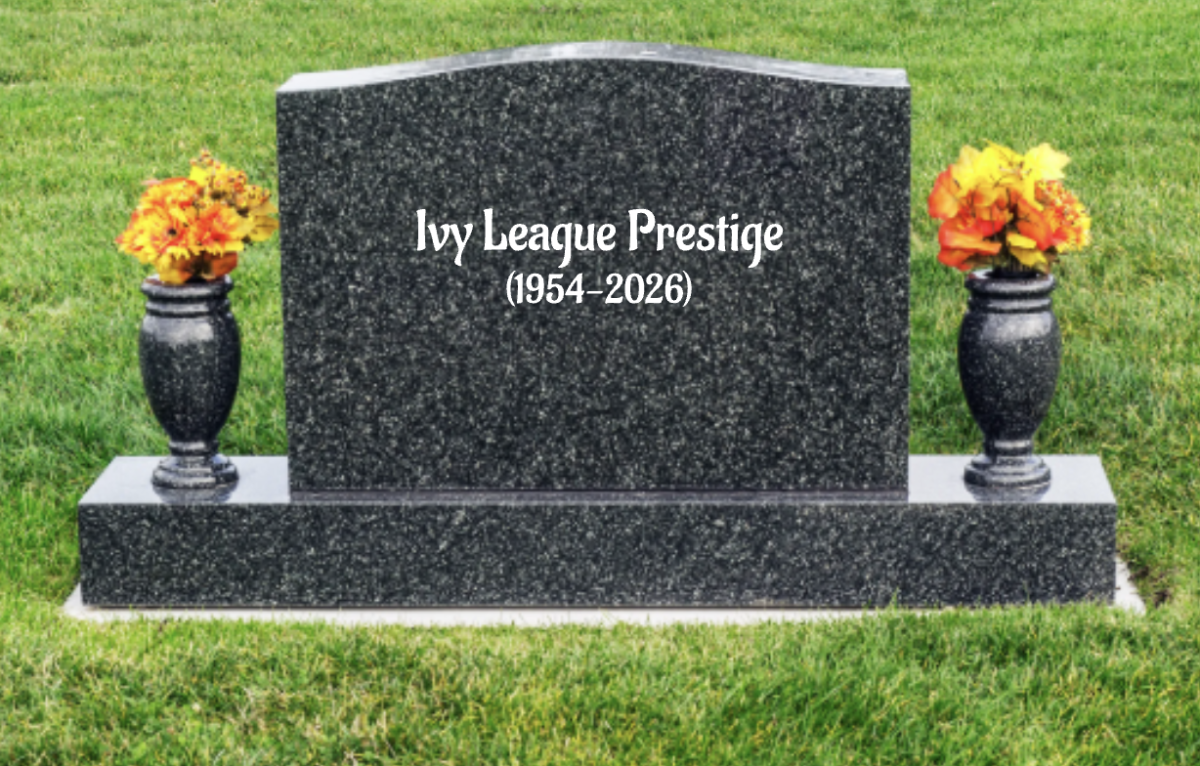
In summation, I would hope any reader of this opinion understands that even the etymology of the word “prestige” is connected to the Latin term for “delusion”. Hence, you should recognize that you don’t have to fall for this trap any longer! I leave you with one more statistic: 95% of the top 10% of Americans never even attended an Ivy League (noting this doesn’t even include those like Facebook founder and Meta CEO Mark Zuckerberg who dropped out of an Ivy League). If you want success, you don’t have to fret because you didn’t get accepted into an Ivy League. Either way, just focus on being the best version of yourself wherever you go to further your academic pursuits. If you do get accepted to an Ivy League, it is a huge honor, but if you don’t, stop selling yourself short. It’s the Ivies that are trying to sell you something after all, and increasingly it’s no longer a guarantee of prestige.